Sunday, 16 June 2013

Somali Muslim went on a stabbing inside an UK mosque with sharp knife. Three men - including a policeman seriously injured.

Mosque Stabbings: Police And Locals 'Heroic'
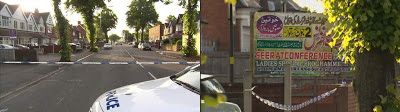
Three people were "seriously" injured when a knifeman went on a stabbing spree inside the mosque.

UK | News Sky dot Com |  16 June 2013::  Police have praised the efforts of officers and the community as "heroic" after three men - including a policeman - were stabbed at a mosque.
They were stabbed with a large combat knife by a fellow worshipper inside the Washwood Heath Muslim Centre in the Ward End area on Saturday night.
A group of worshippers confronted the attacker, who is not known to the mosque, before police arrived minutes later at around 11pm.
One officer used a taser on the suspect but it failed to have an affect on him, said Chief Superintendent Alex Murray. The policeman was knifed in the chest and stomach, around his stab-proof vest.
Chief Supt Murray said: "The work of those officers was heroic and the work of some of the people in the mosque assisting those officers was also heroic."
A 32-year-old man, believed to be of Somali origin, has been arrested on suspicion of attempted murder and is currently in custody.
Reports suggest an argument may have broken out between members inside the building prior to the attack. Police said there was no information to suggest it was a hate crime.
Witness Arshad Mahmood told Sky News: "Everyone was frightened you know, it was so sudden and he had a proper knife with him.
"A few of us we went to stop him, one of the guys was strong enough to stop him. Then I held his hand - the guy who also tried to stop him had an injury on his thigh.
"After a few minutes, a police officer came and he also attacked the police officer."
Three victims, including the officer, suffered "serious" injuries but they are all said to be "stable". One worshipper was stabbed in the arm and one in the leg, while another was slightly hurt.
Mohammed Shafiq, the leader of national Muslim organisation the Ramadhan Foundation, said a nearby resident overheard an argument coming from inside the mosque and believes it followed a dispute between members. See more>>>

Al Qaeda-linked militants blow up Shiite hall in Syria

Qaeda-linked militants blow up Shiite hall in Syria: activists.

Forces loyal to Syria's President Bashar al-Assad are seen in 
Ain-Assan village during what theysaid was an operation to 
occupy it, in southern countryside of Aleppo, June 15, 2013. 
REUTERS/George Ourfalian
BEIRUT | AFP | 16 June 2013:: Extremist fighters claiming to be from an Al-Qaeda-linked group have blown up a Shiite religious building in the Syrian province of Deir Ezzor, activists said on Sunday.

The Syrian Observatory for Human Right said the attack occurred on Friday in the eastern village of Hatlah, where rebel fighters killed at least 60 Shiites earlier in the week.

"Videos show the destruction of a Shiite hussainiyah by the Islamic State of Iraq and the Levant in the village of Hatlah in Deir Ezzor," the group said.

"The destruction was apparently carried out the day before yesterday (Friday)," it added.

Two videos distributed by the Observatory showed fighters who identified themselves as belonging to the Islamic State of Iraq and the Levant inside the religious building, stepping on Shiite books.

The filming then continues from outside the building, as a powerful explosion rips through it to cries of praise from the fighters.

Several then run towards the rubble of the building, waving the black flag associated with extremist Islamist movements.

The Islamic State of Iraq and the Levant is the name for the group created by a merger between Al-Qaeda's Iraqi branch and the jihadist Syrian Al-Nusra Front.

But the merger, announced unexpectedly in April by the leader of the Islamic State of Iraq, Abu Bakr al-Baghdadi, was rejected by Al-Qaeda's top leadership and received cautiously by Nusra's chief.

Earlier this month, Al-Qaeda chief Ayman al-Zawahiri ruled that the Islamic State of Iraq and Nusra should operate independently, but on Saturday Baghdadi insisted the merger would proceed.

The destruction of the hussainiyah comes after fighting between rebels and armed Shiite residents of Hatlah on Tuesday, which left at least 60 Shiites dead, according to the Observatory.

The clashes came after Shiite militiamen from the predominantly Sunni village attacked a nearby rebel checkpoint, the group said.

At least 10 rebels were killed in the subsequent attack on Hatlah, and the fighting prompted most of the villages Shiite residents to flee.

On Saturday, activists said another Shiite religious building was burned by extremist fighters in a nearby village in Deir Ezzor, but there were no additional details on the incident.

The Syrian conflict pits a Sunni-led opposition against the regime dominated by Alawites, whose faith is an offshoot of Shiite Islam.

The fighting has taken on increasingly sectarian overtones, particularly with the entry into the conflict of extremist fighters from other Arab countries.(Courtesy:The Daily Star)


Wave of car bombs kills 20 in south Iraq.

Wave of car bombs kills 20 in south Iraq: officials.

BAGHDAD | AFP | 16 June 2013:: A wave of car bombs in southern Iraq killed 20 people on Sunday as the country grapples with a spike in violence and prolonged political deadlock, sparking fears of all-out sectarian war.
In all, seven vehicles rigged with explosives went off in five cities south of Baghdad during morning rush hour, leaving 56 people wounded in primarily Shia Muslim areas of Iraq.
No group immediately claimed responsibility for the attacks, but Sunni militant groups linked to Al-Qaeda frequently target Shia, whom they regard as apostates, in coordinated attacks.
Car bombs went off in Kut, Aziziyah, Mahmudiyah, Nasiriyah and Basra, officials said.
In Kut, provincial capital of Wasit and 160 kilometres (100 miles) south of Baghdad, a car bomb exploded outside a restaurant in an industrial area packed with vehicle repair garages, killing seven people and wounding 15.
Another car bomb in nearby Aziziyah in the town's main marketplace and near a Shia mosque killed five and wounded 10.
Twin blasts in the southern port city of Basra, meanwhile, killed five people, including a bomb disposal expert looking to defuse one of the rigged vehicles.
Three others were killed in bombings in Nasiriyah and Mahmudiyah.
The violence was the latest in a spike in attacks nationwide, with last month registering the highest death toll since 2008, sparking fears of a return to the all-out sectarian war that blighted Iraq in 2006 and 2007.
There has been a heightened level of unrest since the beginning of the year, coinciding with rising discontent among the Sunni Arab minority that erupted into protests in late December.
Analysts say a lack of effort by the Shia-led authorities to address the underlying causes of the demonstrations has given militant groups fuel and room to manoeuvre to carry out their activities.
The outgoing UN envoy to Iraq Martin Kobler has warned the violence is “ready to explode”. (Courtesy:Dawn)

Female suicide bomber responsible for Quetta attack.

Female suicide bomber responsible for Quetta attack.


People extinguishing fire off the blast 
after a blast at Sardar Bahadur Khan

 Women University.—Online Photo
SYED ALI SHAH | QUETTA | 16 June 2013:: Intelligence officials revealed today that a female suicide bomber carried out the first attack on a bus carrying students of Sardar Bahadur Khan Women’s University earlier on Saturday.
At least 25 people, including the deputy commissioner of Quetta, 14 students of a women’s university and four nurses were killed on Saturday when a bomb tore through a bus, followed by a suicide attack and a gun-battle in the Bolan Medical College hospital, where the injured students were taken for treatment.
Banned outfit Lashkar-i-Jhangvi claimed responsibility for the bomb blasts.
An intelligence official, who requested not to be named, told Dawn.com that a female suicide bomber managed to sneak into the university bus. "When all the students gathered inside the bus, she blew herself up", he said.
Officials said they had no information about the identity of the female suicide bomber.
Moreover, intelligence officials said after the female bomber blew up herself in the bus, a second male bomber followed suit and struck inside the crowded Bolan Medical Complex Hospital to wreak maximum damage.
According to the intelligence personnel, the male suicide bomber was waiting inside BMC Hospital ward for the arrival of high level officials, including the Chief Secretary, and blew up himself when they reached.
Quetta Police Chief Mir Zubair Mehmood also told Dawn.com that the Deputy Commissioner of Quetta Abdul Mansoor Kakar was killed as result of firing outside the hospital. (Courtesy: Dawn)

Saturday, 15 June 2013

Pakistan militants blast bus, attack hospital; at least 21 dead.

Pakistan militants blast bus, attack hospital; at least 21 dead.


QUETTA | Pakistan | 15 June 2013:: Militants in western Pakistan bombed a bus carrying women students on Saturday and then seized part of the hospital where survivors of the attack were taken, killing at least 21 people, officials said. At least 27 were injured.

The gunmen in Quetta, the capital of Baluchistan province long plagued by sectarian violence, were holed up in the emergency ward of a hospital, engulfed in a firefight pitting them against the security forces.

Security forces had forced their way into part of the Bolan Medical Complex, where dozens of patients and staff were believed to be trapped. Television footage showed troops surrounding the building and a helicopter hovering overhead.

"They are several in number, we are still facing resistance from them, and people are stranded inside the hospital. We are trying our best to rescue the people," said Jan Mohammed Bulaidi, spokesman for Baluchistan's new chief minister, who took office last Sunday.

The attack in resource-rich Baluchistan was Pakistan's most lethal since the government of Prime Minister Nawaz Sharif took office last week and followed earlier explosions in a nearby town that killed a policeman and destroyed a historic building.

Quetta is a hotbed of sectarian violence, much of it targeting the Hazara ethnic minority, who are Shia Muslims.
The province is also racked by a separatist insurgency. It was not immediately clear who was responsible for the bus and hospital attacks, or whether they was aimed at the Hazaras.

City police chief Mir Zubair Mehmood told Reuters that the students on the bus were from various ethnic groups, including Hazaras, targets of a series of bombings this year.(Courtesy:The Daily Star)

Roadside bomb kills 5 police in Afghanistan.


Roadside bomb kills 5 police in Afghanistan.

A shoe of a civilian is seen at the site of a suicide
 car bomb attack in Kabul June 11, 2013. 

REUTERS/Omar Sobhani.photo-The Daily Star
KABUL | 15 June  2013:: A roadside bomb struck a police van in eastern Afghanistan on Saturday, killing five police as they were on their way to a training session, authorities said.

Seven other police were wounded in the early morning blast in Paktika province, a statement from the provincial governor’s office said.
The van was taking the officers to a training centre in Janikahil district for exercises between the Afghan National Police and the village-level Afghan Local Police, separate branches of the security forces that international troops have been training. Among the five dead were two national police and three local police.
Bombings, assassinations and gun battles have soared in recent months. The Taliban and other militants have stepped up attacks as Afghan police and soldiers take over full responsibility for security and international forces draw down. The intense militant campaign has pushed violence to levels matching some of the worst of the 12 year-old war. (Courtesy: The Hindu)


26/11 trial: Lakhvi, 6 six others shifted to Islamabad court.


26/11 trial: Lakhvi, 6 six others shifted to Islamabad court.

Fire at Taj Hotel in Mumbai in this November
27, 2008 picture. Photo: Vivek Bendre
Attack by saitanic islam In a move with significant ramifications, the trial of seven Pakistanis, including LeT commander Zakiur Rehman Lakhvi, charged with involvement in the Mumbai attacks was on Saturday shifted from a court in Rawalpindi to a new anti-terrorism court in the capital here.
Judge Chaudhry Habib-ur-Rehman of the Rawalpindi-based anti-terrorism court accepted an application from the prosecution to move the case to the anti-terrorism court of Judge Kausar Abbas Zaidi in Islamabad, sources told PTI.
Judge Zaidi’s court was established recently to hear a case filed against former President Pervez Musharraf under the Anti-Terrorism Act. Till then, Islamabad had no anti-terrorism court and all terrorism cases were heard by courts in Rawalpindi.
Legal experts said fresh proceedings would have to begin in the court in Islamabad and the judge would take some time to acquaint himself with the details of the case. There were no other proceedings during Saturday’s hearing conducted by Judge Rehman behind closed doors.
The government is yet to appoint a new chief prosecutor to replace Chaudhry Zulfiqar Ali of the Federal Investigation Agency, who was assassinated by militants in Islamabad on May 3. Besides the Mumbai attacks, Mr. Ali was also handling the Benazir Bhutto assassination case.
Islamabad Police have arrested a militant with links to the Taliban for alleged involvement in Mr. Ali’s murder.
The Rawalpindi-based anti-terrorism court has been handling the Mumbai attacks case since 2009 though the judge has been changed five times.
The seven Pakistani suspects have been charged with planning, financing and executing the attacks that killed 166 people in Mumbai in November 2008.(Courtesy:The Hindu)